> For the complete documentation index, see [llms.txt](https://docs.akinon.com/llms.txt). Markdown versions of documentation pages are available by appending `.md` to page URLs; this page is available as [Markdown](https://docs.akinon.com/tutorials/oms/webhooks.md).
# Webhooks
This tutorial explains how to add or edit a webhook within the OMS screens. Webhooks are used to transfer events and data from the OMS to third-party software, enabling real-time communication and automation.
## Step 1: Access Webhooks
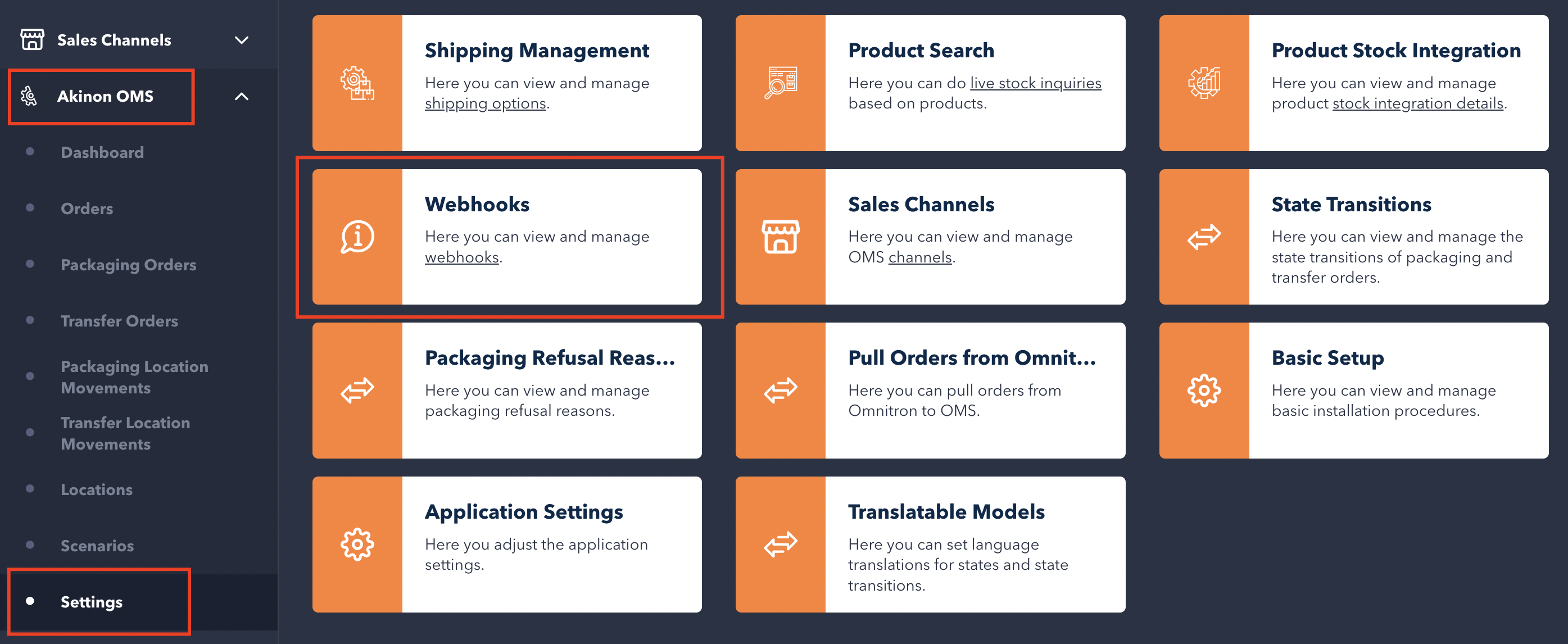
* To add a new webhook, start by selecting the **Settings** tab under the Akinon OMS menu.
* Next, click on **Webhooks**.
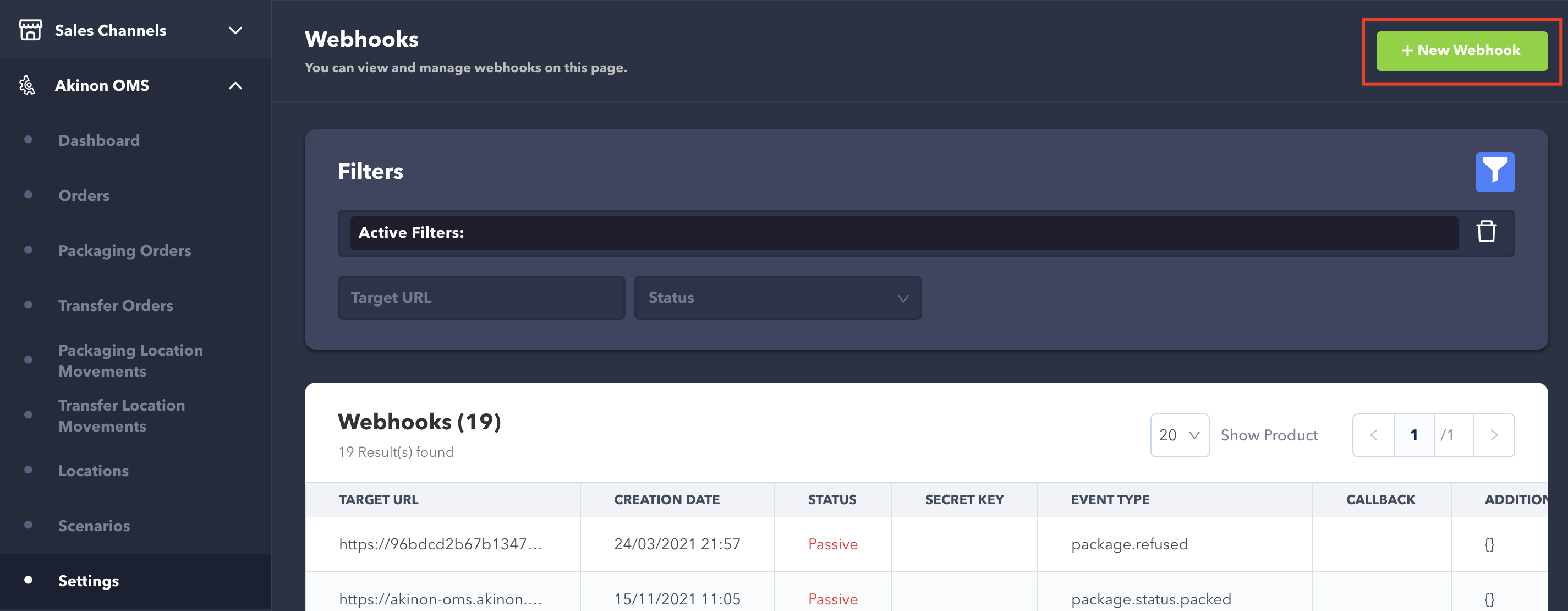
* Click on the **+New Webhook** button to add new webhook.
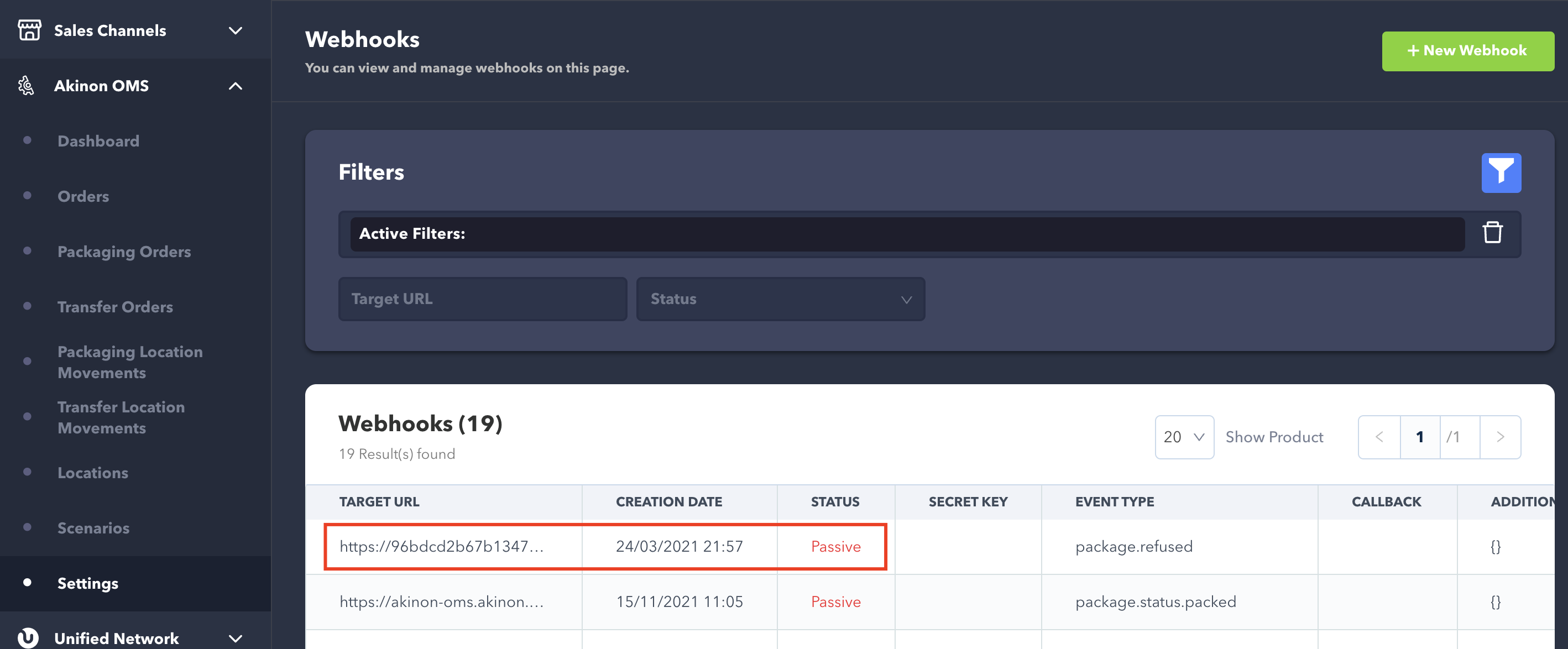
* To edit an existing webhook, follow the same steps to access **Webhooks** under the **Settings** tab. Select the webhook you want to edit from the list and proceed to its details.
## Step 2: Configure Webhook
Akinon OMS uses webhooks to relay the events it triggers to third-party software. These events can include outcomes stemming from OMS actions or updates regarding domain objects' current states.
The data required for the Webhook Form is furnished by the third-party software and can be customized through JSON configuration.
* To add or edit a webhook, you need to provide the following information:
* **Target URL**: The URL that other Akinon or third-party services receive to connect. The URL received by other Akinon or third-party services to connect.
* **Secret Ket**: It is not a required field, if it is provided by other services to be connected.
* **Event Type**: Enter a distinctive name to the Event Type field, especially if you have multiple webhooks, to differentiate them easily.
* **Callback**: This field can be configured via JSON as needed.
* **Additional Headers**: If there is extra data to be sent along with the settings or configuration, enter it here for routing from Akinon OMS to other Akinon or third-party services.
* **Config**: The Config field allows you to provide a JSON Config in accordance with the specifications expected by the webhook.
> **Note:** If there is no Additional Headers or Config to enter, these fields can be left empty by using "**{}**".
* **Retry Countdown Config**: Specify a time interval for retrying data routing through this webhook, if necessary.
* **Status**: Set the Status to **Active** if you want to use this webhook.\
---
# Agent Instructions
This documentation is published with GitBook. GitBook is the documentation platform designed so that both humans and AI agents can read, navigate, and reason over technical content effectively. Learn more at gitbook.com.
## Querying This Documentation
If you need additional information that is not directly available in this page, you can query the documentation by asking a question.
Perform an HTTP GET request on the following URL with the `ask` and `goal` query parameters:
```
GET https://docs.akinon.com/tutorials/oms/webhooks.md?ask=&goal=
```
`ask` is the immediate question: it should be specific, self-contained, and written in natural language.
`goal` is what the user is ultimately trying to achieve, the reason they need the answer. Sharing it helps GitBook give you a better, more relevant answer. A goal is most helpful when it describes the outcome the user wants rather than restating the question. For example, with `ask=how do I create an API token`, a goal like `automate deployments from our CI pipeline` lets GitBook tailor the answer to that use case.
The response will contain a direct answer to the question and relevant excerpts and sources from the documentation.
Use this mechanism when the answer is not explicitly present in the current page, you need clarification or additional context, or you want to retrieve related documentation sections.