> For the complete documentation index, see [llms.txt](https://docs.akinon.com/llms.txt). Markdown versions of documentation pages are available by appending `.md` to page URLs; this page is available as [Markdown](https://docs.akinon.com/technical-guides/omnitron/multi-subdomain-configuration.md).
# Multi-Subdomain Configuration
This document outlines the steps required to implement and support **multi-subdomain setups** in a commerce architecture. It includes frontend configurations, authentication adjustments, domain mappings in the Omnitron, and subdomain-specific email template management.
## Implementation Checklist
* [x] **Set locale URL strategy to Subdomain**
* [x] **Update Auth handler for dynamic hostname and cookie domain**
* [x] **Configure Domain Name per Sales Channel**
* [x] **Assign Email Templates to Specific Subdomains**
## FRONTEND CONFIGURATION
### 1. Setting the Locale URL Strategy to Subdomain
In order to enable locale handling via subdomains (e.g., `en.example.com`, `fr.example.com`), update the locale URL strategy in the frontend project settings.
**File:** `src/settings.js`
**Configuration:**
```js
localeUrlStrategy: LocaleUrlStrategy.Subdomain
```
### 2. Configuring Dynamic Hostname and Cookie Handling for Auth
To properly handle authentication cookies across multiple subdomains, you need to configure the authentication handler (`[...nextauth].ts`) to dynamically compute the `hostname` and apply the correct cookie `domain`.
**File:** `src/pages/api/auth/[...nextauth].ts`
```ts
import Auth from '@akinon/next/api/auth';
import getRootHostname from '@akinon/next/utils/get-root-hostname';
import type { NextApiRequest, NextApiResponse } from 'next';
const customOptions = (req: NextApiRequest) => {
const fallbackHost = req.headers['x-forwarded-host'] || req.headers.host || '';
const baseUrl = process.env.NEXT_PUBLIC_URL || `https://${fallbackHost}`;
const hostname = getRootHostname(baseUrl);
const isHttps = baseUrl.startsWith('https://') || process.env.NODE_ENV === 'production';
if (!isHttps || !hostname) {
return {};
}
process.env.NEXTAUTH_URL = `https://${fallbackHost}`;
return {
cookies: {
sessionToken: {
name: `${isHttps ? '__Secure-' : ''}next-auth.session-token`,
options: {
domain: hostname,
httpOnly: true,
sameSite: 'lax',
path: '/',
secure: isHttps,
},
},
},
};
};
export default function handler(req: NextApiRequest, res: NextApiResponse) {
return Auth(req, res, customOptions);
}
```
{% hint style="warning" %}
This setup ensures that the session cookie is properly scoped to the root domain (e.g., `.example.com`) and works across all subdomains securely.
{% endhint %}
## OMNITRON CONFIGURATION
### 1. Domain Name Configuration per Sales Channel
In the Omnitron, navigate to: **Settings → Sales Channel Settings**
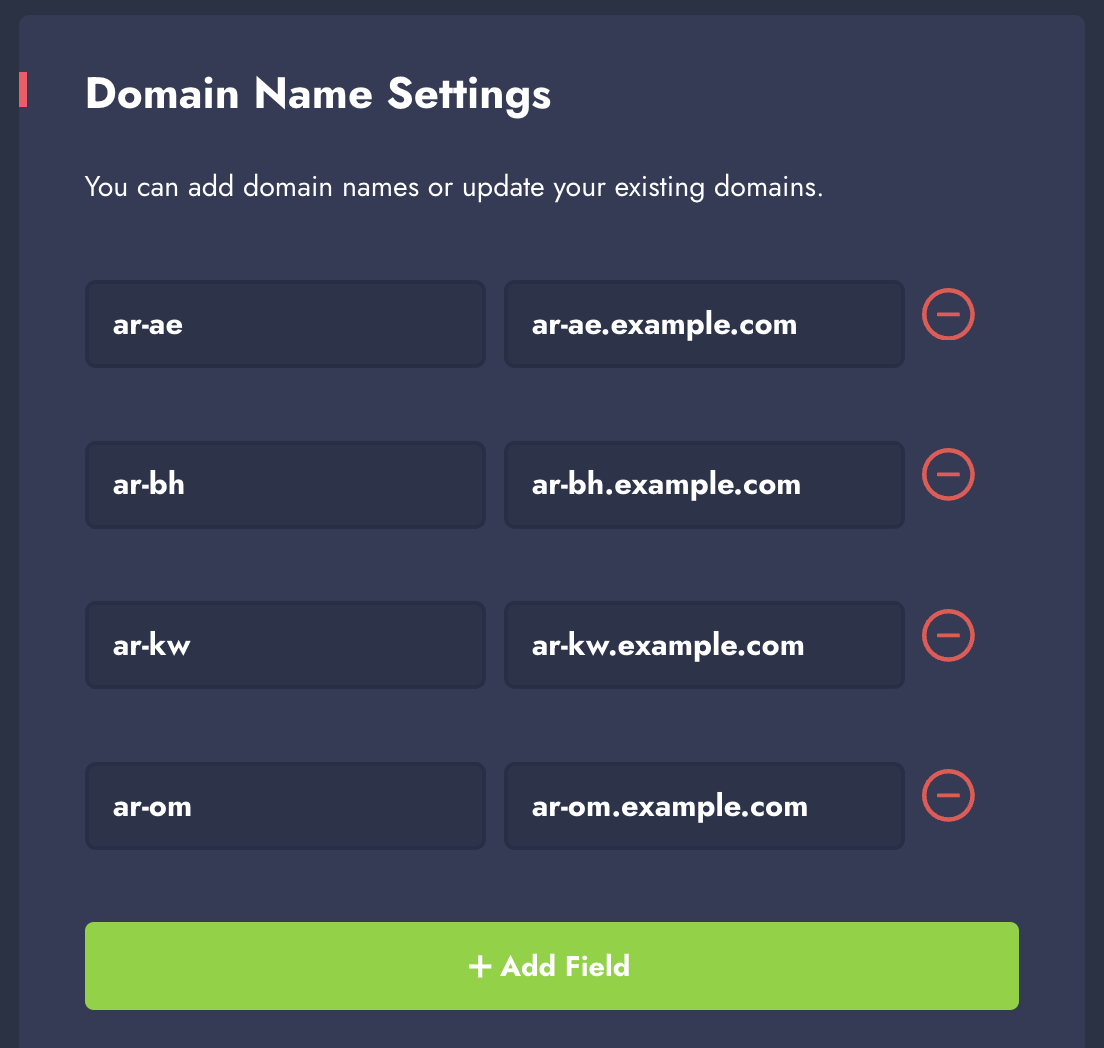
Under the corresponding sales channel, configure the **Domain Name Settings** to include all required subdomains (e.g., `ar-ae.example.com`, `ar-bh.example.com`, `ar-kw.example.com`, etc.).
This ensures that all subdomains are recognized and correctly handled in routing, content delivery, and environment-based logic.
### 2. Subdomain-Specific Email Template Assignment
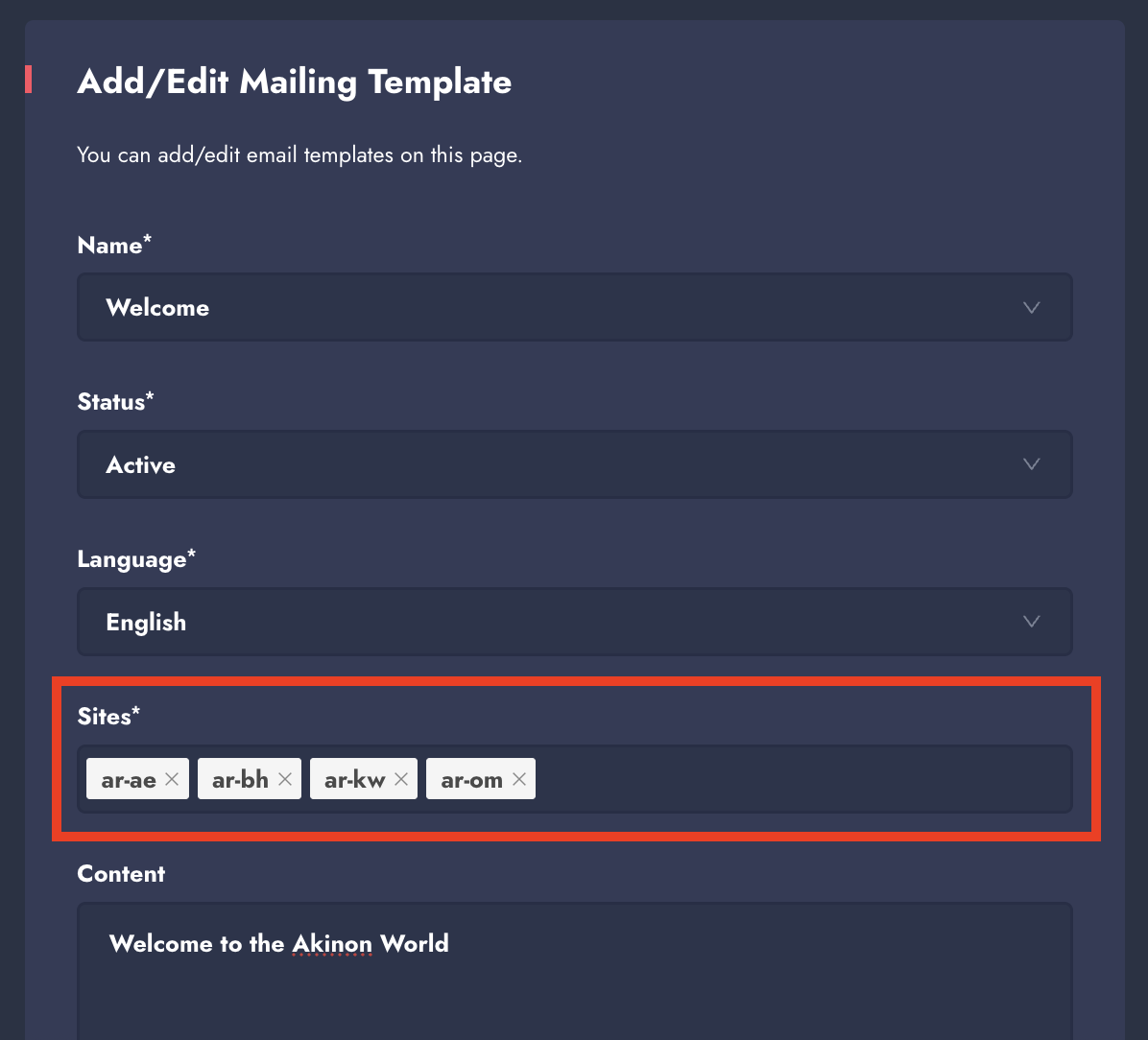
To send different email templates based on subdomain (e.g., locale or region-specific content), follow these steps:
Navigation: **Sales Channels → Content Management → Mailing Templates**
* Select the email template you wish to customize.
* Within the template configuration screen, locate the **Sites** field.
* Select the appropriate subdomains (sites) where this template should be active.
This allows for targeted transactional or marketing emails tailored by region, locale, or brand variation via subdomain separation.
{% hint style="danger" %}
In multi-subdomain setups, attaching SSL certificates is currently handled **manually** on the ACC side.\
For such cases, please **open a ticket with Akinon Partner Support** to request certificate attachment.
{% endhint %}
---
# Agent Instructions
This documentation is published with GitBook. GitBook is the documentation platform designed so that both humans and AI agents can read, navigate, and reason over technical content effectively. Learn more at gitbook.com.
## Querying This Documentation
If you need additional information that is not directly available in this page, you can query the documentation by asking a question.
Perform an HTTP GET request on the following URL with the `ask` and `goal` query parameters:
```
GET https://docs.akinon.com/technical-guides/omnitron/multi-subdomain-configuration.md?ask=&goal=
```
`ask` is the immediate question: it should be specific, self-contained, and written in natural language.
`goal` is what the user is ultimately trying to achieve, the reason they need the answer. Sharing it helps GitBook give you a better, more relevant answer. A goal is most helpful when it describes the outcome the user wants rather than restating the question. For example, with `ask=how do I create an API token`, a goal like `automate deployments from our CI pipeline` lets GitBook tailor the answer to that use case.
The response will contain a direct answer to the question and relevant excerpts and sources from the documentation.
Use this mechanism when the answer is not explicitly present in the current page, you need clarification or additional context, or you want to retrieve related documentation sections.