> For the complete documentation index, see [llms.txt](https://docs.akinon.com/llms.txt). Markdown versions of documentation pages are available by appending `.md` to page URLs; this page is available as [Markdown](https://docs.akinon.com/tutorials/omnitron/sales-channels/category-management/how-to-automatically-assign-category-mapping-rules-in-omnitron.md).
# How to Automatically Assign Category Mapping Rules in Omnitron?
This tutorial provides step-by-step instructions for automatically assigning rules for category mapping operations in Omnitron.
## Step 1: Access to Omnitron
* Get access to the **Omnitron** panel.
* Enter your *Username* and *Password*, and then click the **Sign In** button.\

## Step 2: Navigate to Category Mapping Page
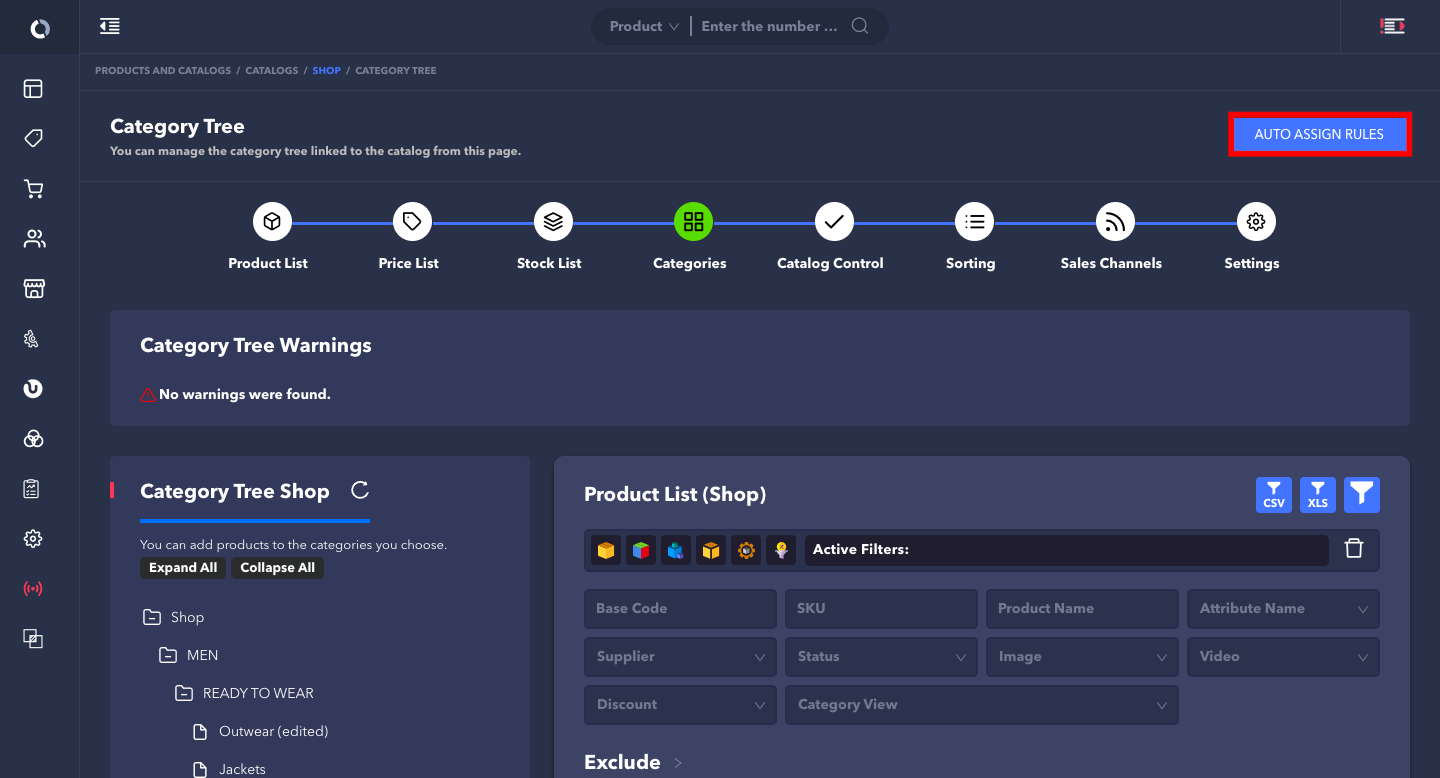
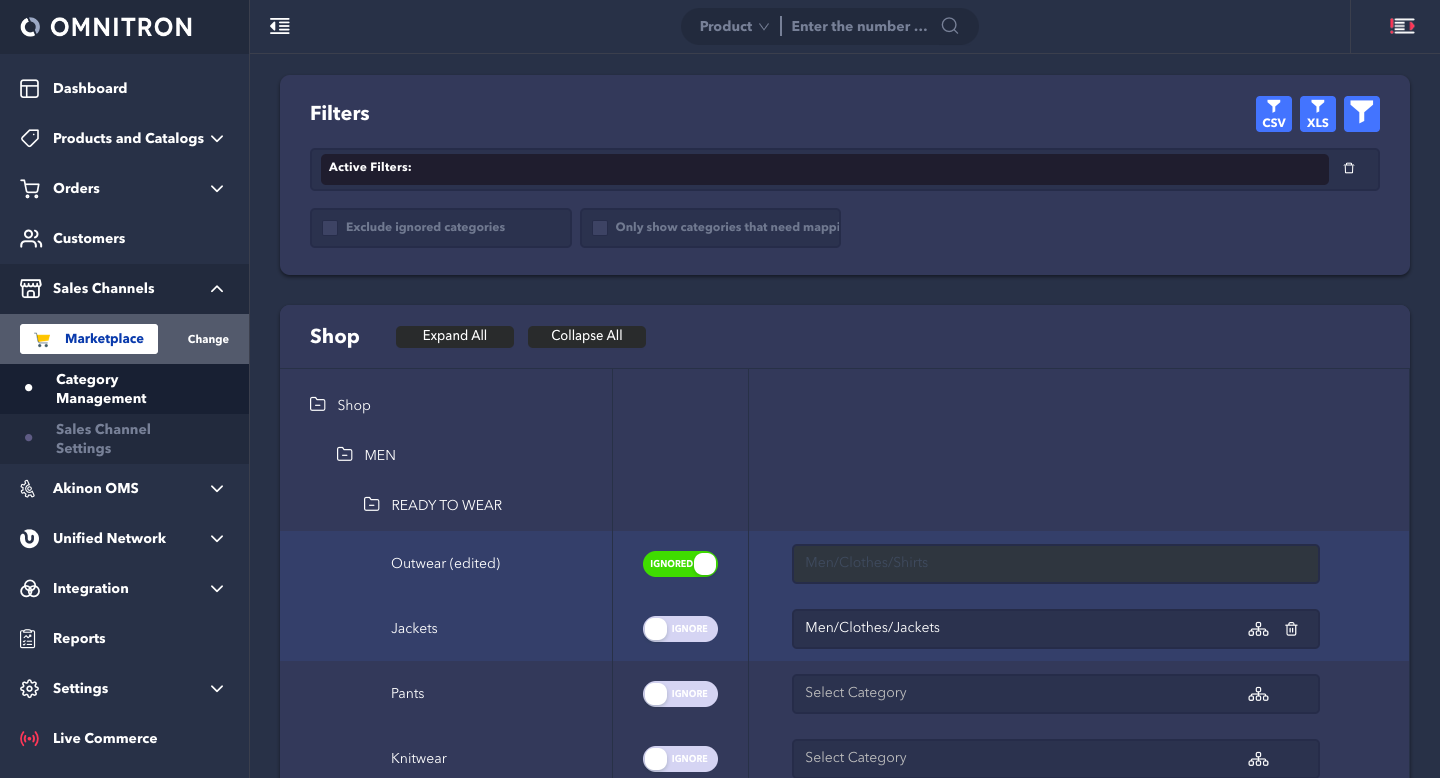
* Follow the **Products and Catalogs > Catalogs > Category Tree** or **Sales Channels > Category Management** steps and click on the **Auto Assign Rules** button to reach the **Category Mapping** page.
* *Category Mapping* is used for automatically assigning the category node to products for related Sales Channel.
* *Category Mapping* action can be taken for both marketplaces and web-type of sales channels. The path may change as above depending on the sales channel where the action will be taken.
*Auto Assign Rules* button, following **Products and Catalogs > Catalogs > Category Tree** steps
*Auto Assign Rules* button, following **Sales Channels > Category Management** steps
## Step 3: View Category Mapping Page
* By clicking on the **Auto Assign Rules**, the **Category Mapping** page can be seen.
* Category Mapping page includes two different tabs,
* *Category to Category* tab
* In which different categories from different catalogs can be mapped directly.
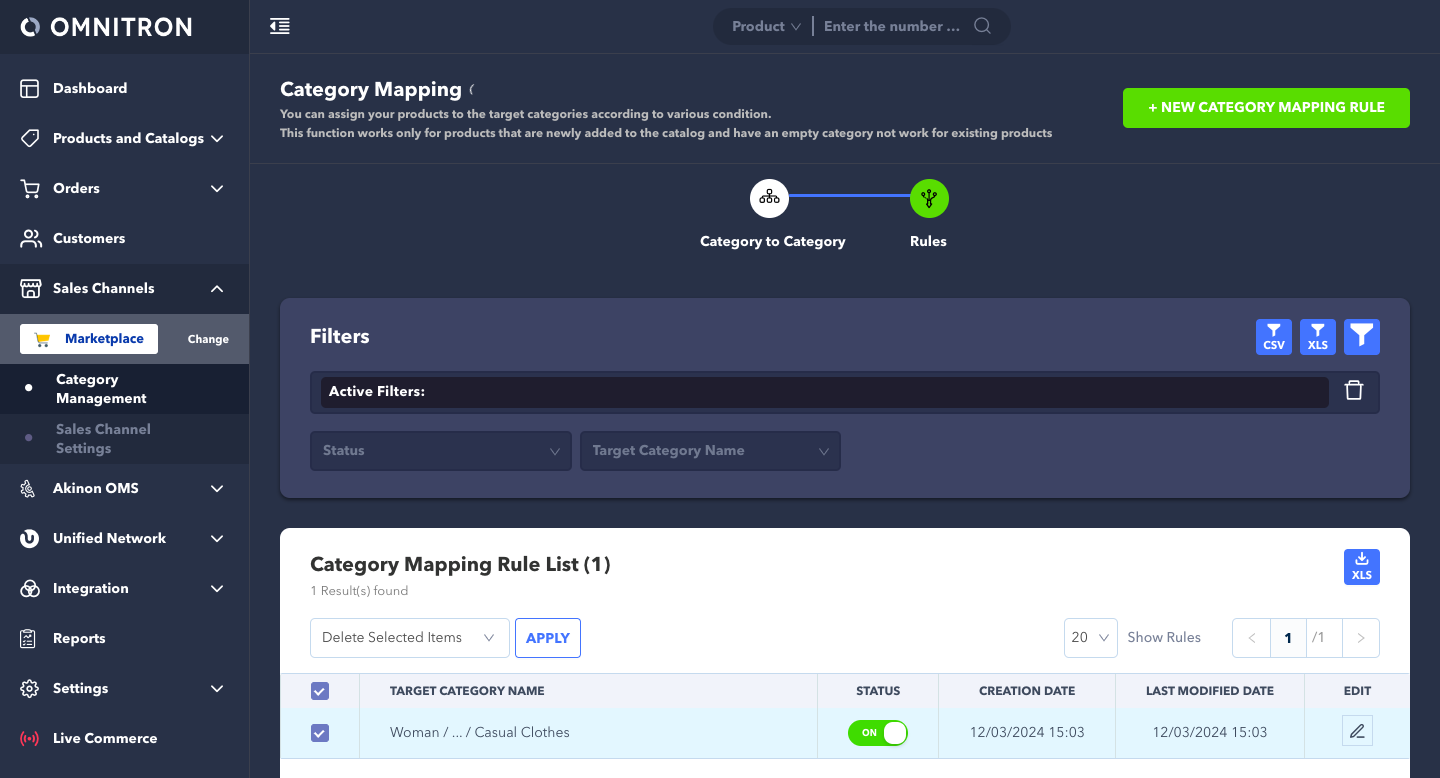
* *Rules (Product to Category)* tab
* In which rule-based product to category mapping can be made.
* Users can;
* view the *Source Category Tree* for the Category to Category mapping,
* view the *Source Category Nodes* and map these nodes to the selected Sales Channel’s Category Nodes (*Target Category Nodes*)
* make Category to Category mapping ignored
* filter Category to Category Mappings by *Excluding Ignored Categories* or *Showing Categories That Need Mapping,*
* view the schema of the *Target Category Nodes* on the *Category to Category* tab.
* Users also can;
* view, create, update and delete the Category Mapping Rules,
* filter Rules with respect to the *Status* and *Target Category Name* on the *Rules (Product to Category*) tab.
## Step 4: Add/Update “Category to Category” Mapping
* After selecting a *Source Category Tree* and clicking on the **Apply** button, the selected Category Tree can be seen on the **Category to Category** tab.
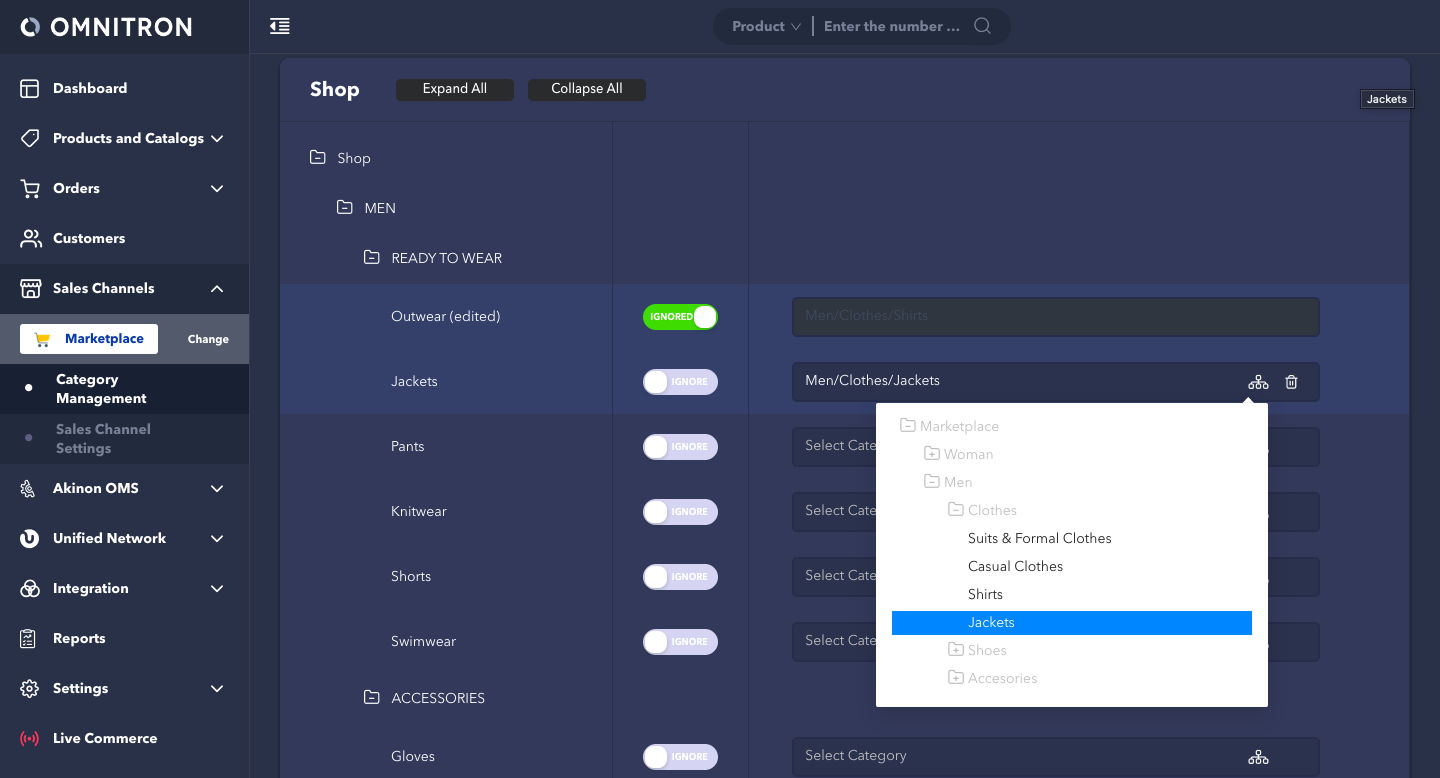
* Listed source categories can be mapped
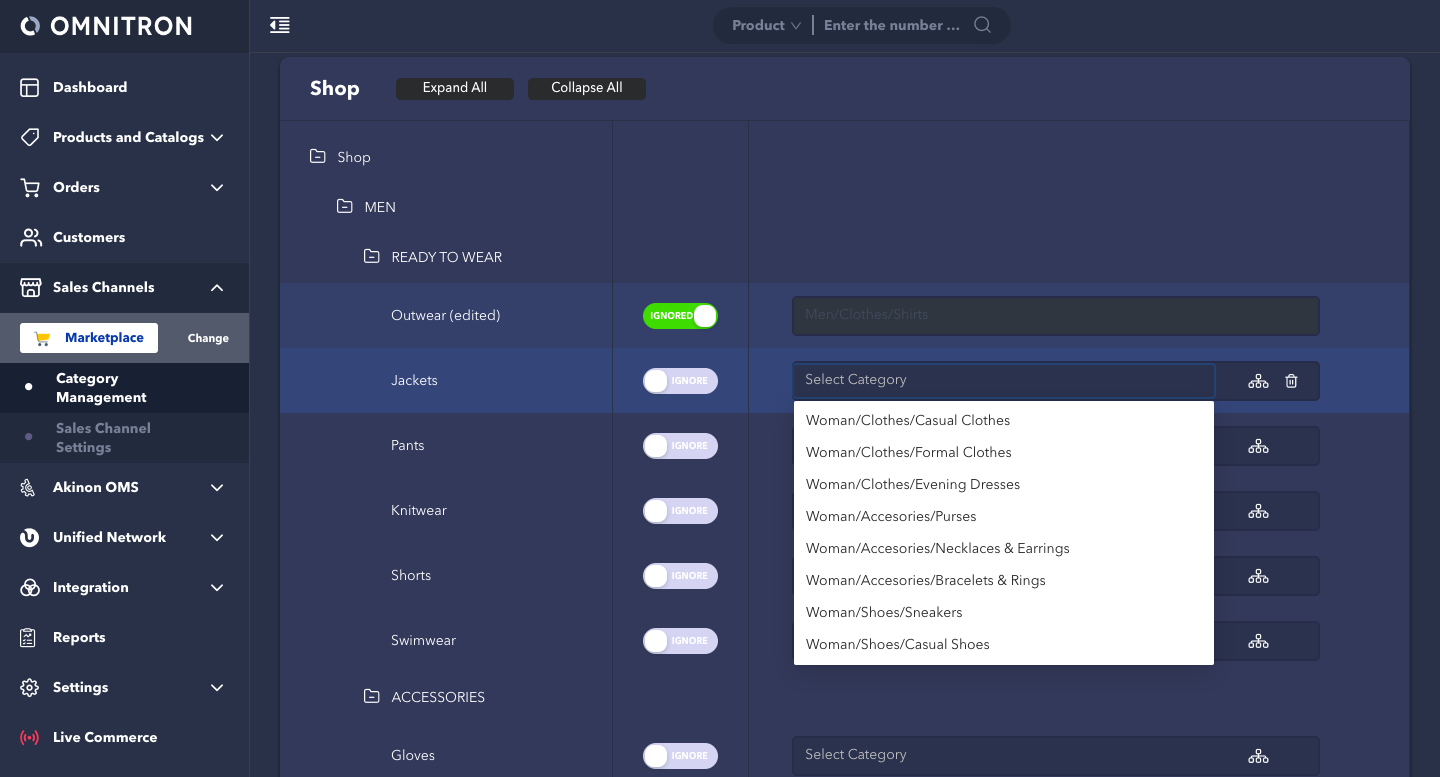
* by clicking on the dropdown and selecting the target category nodes, or
* by clicking on the schema icon and selecting the target category nodes.
* Mapped categories can be edited by the same steps above.
* Mapped categories can be deleted by clicking on the *Delete Icon.*
For products added to the catalog, category assignments are automatically made to the target category node with respect to the relevant *Category to Category Mapping*.
*Creating / Updating “Category to Category Mapping” by clicking on the dropdown and selecting the target category nodes*
*Creating / Updating “Category to Category Mapping” by clicking on the schema icon and selecting the target category nodes.*
{% hint style="info" %}
Please note that the “*adding products to the catalog*” operation should be done after the *Category to Category Mapping* is completed.
{% endhint %}
{% hint style="info" %}
Please note that only the “leaf” source and target categories can be mapped to each other (leaf categories: sub-category nodes that do not have any child category nodes).
{% endhint %}
## Step 5: Add/Update Category Mapping Rule
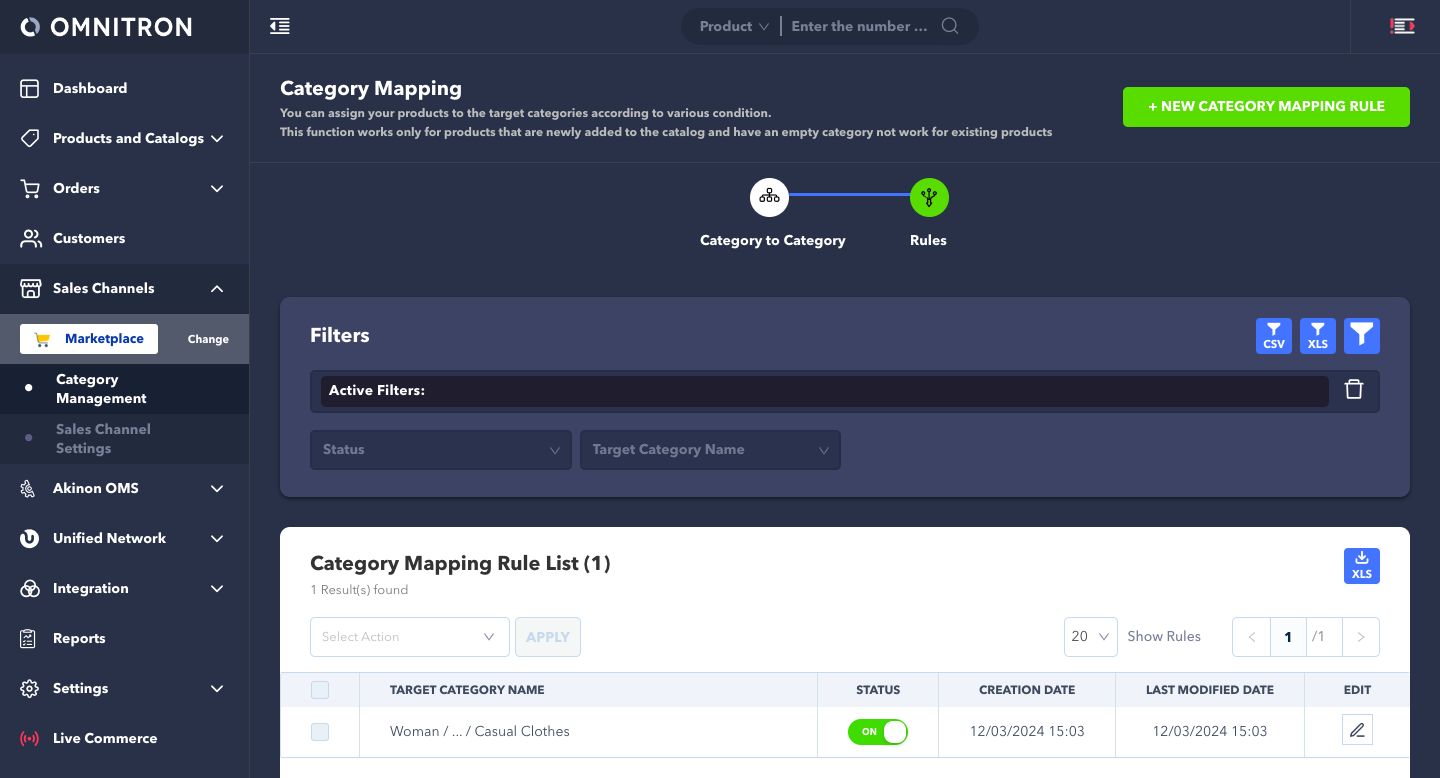
* Clicking on the **Rules** button on the Category Mapping page, **Category Mapping Rules** can be seen as a list.
* By clicking on the **+ New Category Mapping Rule** button, or clicking on the **Edit** icon on the listed category mapping rules, **Add / Edit Category Mapping Rule** **Form** can be opened.
* Users can;
* select a *Target Category Name*,
* give rule(s) to the *Target Category Node* by selecting one or multiple *Attribute Name, Condition Processor* and *Attribute Value* for the *Category Mapping Rule*.
For products added to the catalog, category assignments are automatically made to the target category node with respect to the relevant *Category Mapping Rule*.
*One Rule can include multiple Attribute Name, Condition, Attribute Value groups*
{% hint style="info" %}
The “*adding products to the catalog*” operation should be done after the *Category Mapping Rule* is created.
{% endhint %}
{% hint style="info" %}
Only the “leaf” source and target categories can be mapped to each other (leaf categories: sub-category nodes that do not have any child category nodes).
{% endhint %}
{% hint style="info" %}
*Category to Category Mapping* and *Category Mapping Rules* can be formed for the same *Target Category Node*. In this case, the product assignment to the Target Category Node, provided that the product has been added to the catalog, is automatically made with respect to both mapping rules.
{% endhint %}
## Step 6: Delete Category Mapping Rule
* Listed Category Mapping Rules can be deleted by selecting the “Delete Selected Items” option and clicking on the **Apply** button.
---
# Agent Instructions
This documentation is published with GitBook. GitBook is the documentation platform designed so that both humans and AI agents can read, navigate, and reason over technical content effectively. Learn more at gitbook.com.
## Querying This Documentation
If you need additional information that is not directly available in this page, you can query the documentation by asking a question.
Perform an HTTP GET request on the following URL with the `ask` and `goal` query parameters:
```
GET https://docs.akinon.com/tutorials/omnitron/sales-channels/category-management/how-to-automatically-assign-category-mapping-rules-in-omnitron.md?ask=&goal=
```
`ask` is the immediate question: it should be specific, self-contained, and written in natural language.
`goal` is what the user is ultimately trying to achieve, the reason they need the answer. Sharing it helps GitBook give you a better, more relevant answer. A goal is most helpful when it describes the outcome the user wants rather than restating the question. For example, with `ask=how do I create an API token`, a goal like `automate deployments from our CI pipeline` lets GitBook tailor the answer to that use case.
The response will contain a direct answer to the question and relevant excerpts and sources from the documentation.
Use this mechanism when the answer is not explicitly present in the current page, you need clarification or additional context, or you want to retrieve related documentation sections.